
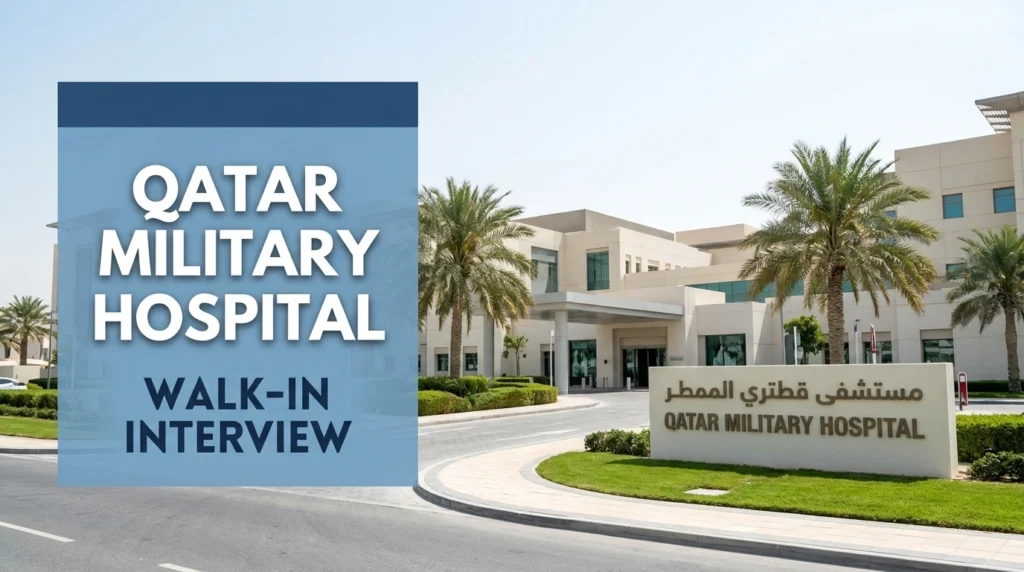
For licensed medical professionals already inside Qatar, Qatar Military Hospital Walk In Interview represents one of the most secure and stable government healthcare postings available, with base commanders recruiting frontline clinical workers directly into Doha’s defense cantonment facilities. Hamad Medical Corporation and Qatar’s military medical network together form one of the most well-funded healthcare systems in the GCC, offering competitive government-backed compensation packages. Only Qatar residents with an active QID and flawless CEID police clearance are considered, as security vetting begins before candidates even enter the assessment building.
Rolling up to a fortified checkpoint with a half-printed CV will literally get you detained by the military police. You cannot even step foot into the visitor scanning room unless your physical QID and a flawless CEID police clearance are ready for inspection.
Pulling a shift on these classified wards means locking your smartphone away and operating under absolute communication blackouts. Every single medical decision requires strict sign-off throughout the defense chain of command to protect the identities of injured officers.
EXPERT VERDICT: THE CEID SECURITY BLOCK
Our Analysis: Military recruitment is completely different from applying to Hamad or Sidra. Even if your clinical skills are world-class, the Ministry of Defense will reject you instantly if your CEID (Criminal Evidences and Information Department) file shows a single bounced cheque or unpaid telecom bill. They require absolute financial and legal zero-risk candidates.
Expert Pro Tip: Always carry your physical, original Ministry of Public Health (MoPH) evaluation alongside your QID. Defense recruiters want ready-to-transfer staff who can legally touch a patient the very next morning without triggering bureaucratic delays.
Clinical Compensation: What the Armed Forces Pay (2026)
| Role | Est. Monthly Salary (QAR) | Working Environment |
| ER / Trauma Nurse | 9,000 – 15,000 QAR | High-security wards, active duty |
| Biomedical Technician | 7,500 – 12,000 QAR | Classified equipment maintenance |
| VIP Ward Hostess | 5,000 – 8,000 QAR | Officer family floors, Arabic preferred |
| Medical Records Clerk | 4,500 – 6,500 QAR | Data entry, extreme privacy rules |
The Cantonment vs. The Officer Clinics: Where You Actually Work
Military directors strictly assign civilian staff based on their security clearance levels and Arabic language fluency.
The Active-Duty Trauma Wards
Handling the main emergency bay means dealing with specialized injuries from live-fire training exercises.
- Rapid Stabilization: Process severe physical trauma cases using restricted military medical supplies before transferring soldiers to surgery.
- Secure Logging: Enter patient vitals directly into the isolated defense health database that does not connect to the outside internet.
The VIP Family Suites
Working on the officer family floors requires extreme diplomacy and absolute silence regarding who is admitted.
- Cultural Navigation: Provide seamless, luxury-grade care to high-ranking officials without violating strict ward privacy protocols.
- Direct Escort: Coordinate with armed internal security to transport classified patients to the radiology department
The Hidden Reality of Military Contracts
- Zero-Device Zones: You must surrender your smartphone at the security gate every single morning; possessing a camera inside the ward is a jailable offense.
- Strict Leave Blackouts: Annual leave requests are frequently cancelled or blocked entirely if the military goes on high-alert status.
- Bureaucratic Hierarchy: You cannot simply complain to a friendly HR manager; all floor disputes must follow a rigid, multi-step chain of command.
- Instant Termination: Leaking a patient’s name to the outside world results in immediate visa cancellation and a permanent GCC travel ban.
FEATURED “HOT JOB”: MILITARY ER TRAUMA NURSE
The defense sector needs hardcore, stress-tested nurses to manage the main cantonment emergency rooms.
- Compensation: 12,000 QAR Base + Secure Facility Allowances.
- Placement: Qatar Armed Forces Medical Services (Doha Base).
- Benefits: Premium government housing, annual family flights, and extensive end-of-service gratuity.
Core Requirements:
- Valid QCHP Registered Nurse License physically in hand.
- Current BLS, ACLS, and ITLS (International Trauma Life Support) cards.
- Minimum 4 years of Level 1 trauma or military medical experience.
- Spotless local police record for immediate security clearance.
Simple Steps To Join The Qatar Military Hospital Team
Military selection panels do not care about your bedside manner. They are testing whether you are a security risk and if your trauma reflexes can handle a live-fire casualty.
The Mandatory Careers Portal Sync
Approaching a fortified checkpoint with loose printed papers is a guaranteed rejection.
- You must physically display your active, pre-registered candidate profile from the official Qatar Armed Forces careers webpage on your smartphone.
- Scanning this specific digital application number allows military intelligence to instantly pull your CEID police clearance before unlocking the turnstiles.
The QCHP License Verification
The defense health directors will heavily scrutinize your local medical standing before they let you see any clinical data.
- Hand over your original QCHP evaluation and an unexpired sponsor NOC directly to the nursing supervisors.
- Clearing this exact paperwork check proves you are legally ready to operate on a patient tomorrow morning without waiting for ministry approvals.
The Classified Trauma Trial
Senior medical officers will put you through a timed clinical simulation to measure your real-time crisis response.
- You have to write down an immediate stabilization protocol for a training casualty using only restricted military medical supplies.
- Passing this speed test proves you can handle the intense pressure of the surgical intensive care unit without violating defense privacy laws.

Haris Khan is a seasoned career consultant and GCC job market specialist with years of hands-on experience in technical recruitment and digital publishing. He specializes in tracking workforce demands across Dubai, Abu Dhabi, Saudi Arabia, and Qatar, helping job seekers connect directly with top-tier corporate employers, engineering firms, and luxury hospitality groups. Haris provides transparent, daily insights on walk-in interviews and direct HR hiring trends to safeguard candidates against recruitment scams and help them accelerate their career growth in the Gulf.