
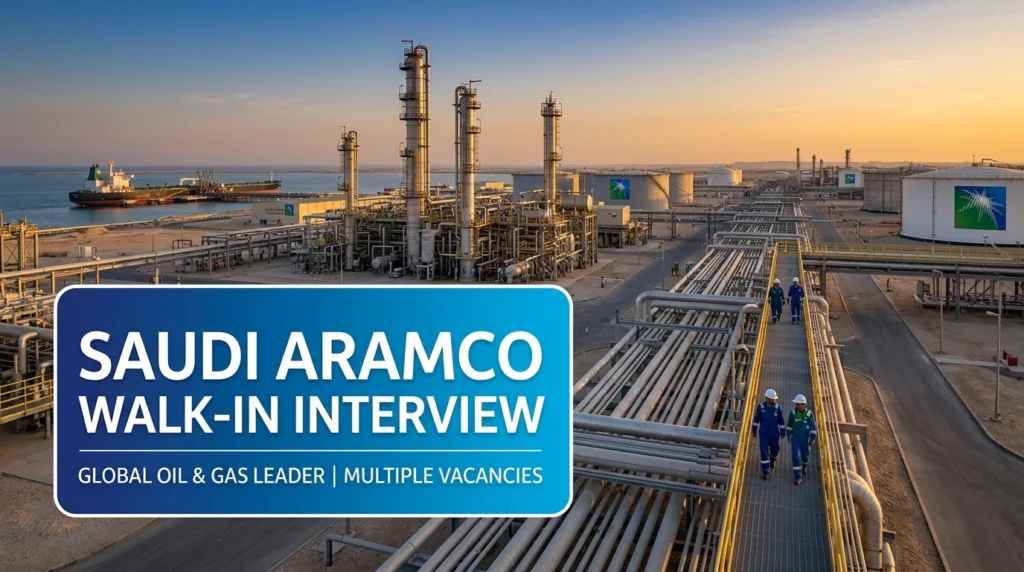
Refinery engineers, process technicians, and offshore field operators looking for placements in the Jafurah gas basin or Safaniya fields can attend Saudi Aramco Walk In Interview conducted through authorized SMP vendors including SRACO and Hakbany. A transferable Iqama, valid Qiwa profile, and Aramco SAP number or CBT clearance are mandatory to pass the initial screening. Prepare your Saudi ID, experience certificates, and passport copy before heading to the recruitment event.
Forget the standard corporate HR screening. The technical evaluators running these drives are strictly looking for plug-and-play manpower. If you don’t hold a transferable Qiwa profile, a valid Saudi Iqama, and most importantly, a verifiable Aramco SAP number or passed CBT (Computer Based Testing) clearance, you will likely be turned away at the door.
Below is the ground-level truth about the SMP contracting system, the reality of remote desert camp life, and how to survive the ruthless technical screening.
EXPERT VERDICT: DIRECT HIRE VS. SMP CONTRACTOR?
Our Analysis: Finding a direct Saudi Aramco walk-in for a permanent staff role is practically a myth; 99% of these open days are for SMP (Supplemental Manpower) companies. Working for an SMP means you are legally employed by the agency but work entirely on Aramco facilities under their strict regulations. You will not get the legendary Aramco compound housing or direct profit-sharing, but the basic salaries offered by these contractors are still massively higher than standard GCC market rates.
Expert Pro Tip: The absolute golden ticket in Saudi oil and gas is the “Aramco Approved” status. If you are a QA/QC Inspector or Safety Officer and have previously passed the Aramco CBT exam, write “ARAMCO APPROVED (CBT PASSED) & SAP ID: [Number]” at the very top of your CV in bold red letters. The recruiter will literally pull you out of the waiting line.
Core Industrial Roles & KSA Pay Scales (2026 Estimates)
| Role | Est. Monthly Salary | Working Environment |
| QA/QC Inspector (CBT Passed) | 12,000 – 18,000 SAR | Pipeline fabrication, site auditing |
| Safety / WPR (Work Permit Receiver) | 7,000 – 11,000 SAR | Plant shutdowns, hazardous zones |
| Heavy Equipment Operator | 4,000 – 7,000 SAR | Earthmoving, strict LOTO adherence |
| Mechanical/Piping Engineer | 14,000 – 22,000 SAR | LSTK projects, contractor management |
Top Hiring Zones Across the Eastern Province
The sheer geographical scale of these energy projects means recruiters are staffing for highly isolated zones, demanding severe physical and mental resilience. Depending on your discipline, you will be deployed to vastly different ecosystems.
1. The Empty Quarter (Rub’ al Khali) Rigs
Deep desert exploration where isolation is the biggest challenge.
- Daily Tasks: Maintaining heavy drilling equipment, managing mud circulation systems, and surviving extreme sandstorms.
- Requirements: Exceptional psychological endurance. Rotations here are usually strict (e.g., 60 days on / 30 days off) and you will be completely cut off from major cities, living entirely within secure contractor camps.
2. Downstream & Petrochemicals (Jubail & Yanbu)
The massive industrial cities handling the refining and chemical processing of crude assets.
- Daily Tasks: Executing tight-deadline “turnaround” (shutdown) maintenance, replacing large heat exchanger bundles, and strictly enforcing confined-space entry rules.
- Requirements: Flawless understanding of Lock-Out/Tag-Out (LOTO) A single mistake with pressurized chemical lines here is catastrophic, so recruiters demand zero-error track records.
The Ground Reality of KSA Energy Contracts
- The Iqama Profession Trap: Saudi labor law is incredibly strict regarding your official job title. If your Iqama (residency permit) says “Laborer” or “Driver,” but you are interviewing for a “Safety Officer” role, the SMP contractor cannot legally deploy you to an Aramco site. Your Iqama profession MUST match your engineering/technical degree.
- The WPR Bottleneck: To supervise any hazardous work on an Aramco site, you need a certified Work Permit Receiver (WPR) You cannot just buy this; you must pass a grueling internal Aramco exam. Agencies heavily prioritize candidates who already hold an active WPR card.
- Camp Life and Transportation: You will likely be living in shared portacabins in industrial zones. Your daily routine will consist of a bumpy bus ride to the facility gate, rigorous security checks, 10-12 hours of fieldwork in 45-degree heat, and the bus ride back.
FEATURED “HOT JOB”: REFINERY CONSOLE OPERATOR
The massive downstream refining division needs highly focused technical staff to monitor live chemical data, control heavy oil pumps, and maintain safe pressure levels across the entire plant from the central computer room.
- Compensation: 9,500 SAR Base (Plus night shift and remote location allowance).
- Placement: Ras Tanura Refinery Complex (Eastern Province, Saudi Arabia).
- Benefits: Secure family housing inside the Aramco camp, world-class medical coverage at Johns Hopkins Aramco Healthcare, and annual paid flight tickets.
Core Requirements:
- Watching multiple flashing computer screens constantly to catch any sudden drops in boiling oil temperature inside the main refinery towers.
- Pressing digital emergency stop buttons immediately if the huge gas compressors start vibrating dangerously during the late-night shift.
- Communicating clearly through a radio headset with the outside field workers to confirm that the heavy iron valves are completely closed.
- Writing exact hourly production numbers into the digital shift logbook so the morning engineers know exactly how much jet fuel was created.
Surviving the SMP Contractor Vetting Process
You aren’t just sitting for a casual HR chat; these agencies act as aggressive gatekeepers protecting the client’s multi-billion dollar assets from incompetent hands.
The “CBT Clearance” Hurdle
For engineering and inspection roles, the interview is just a formality. The real test is the Aramco CBT (Computer Based Testing) administered via Prometric centers. If you fail this highly technical, code-heavy exam, the contractor will drop your application instantly, regardless of how good your interview was.
Aramco Contractor Profile Feed
The automated procurement system pushes your engineering data directly onto the vendor’s active deployment dashboard.
- To apply, you’ll need to login to the Saudi Aramco careers platform and select your specific plant operations or safety discipline.
- You can lock your verified industry certifications and past Aramco project codes onto the digital sheet so the technical evaluators can approve your file before the walk-in panels open.
The Document Verification Audit
Bring your original degrees and experience letters. Saudi Arabia mandates that all engineering and technical degrees be verified through DataFlow and attested by the Saudi Embassy and the Saudi Council of Engineers (SCE). If you lack SCE membership, your Iqama cannot be renewed or transferred, making you useless to the recruiter.

Haris Khan is a seasoned career consultant and GCC job market specialist with years of hands-on experience in technical recruitment and digital publishing. He specializes in tracking workforce demands across Dubai, Abu Dhabi, Saudi Arabia, and Qatar, helping job seekers connect directly with top-tier corporate employers, engineering firms, and luxury hospitality groups. Haris provides transparent, daily insights on walk-in interviews and direct HR hiring trends to safeguard candidates against recruitment scams and help them accelerate their career growth in the Gulf.