
Licensed field engineers and electrical technicians with experience on live power networks have a direct government employment opportunity through SEWA Walk In Interview, where municipal directors are placing qualified candidates straight onto the city grid without lengthy bureaucratic delays. SEWA is Sharjah’s sole government authority managing electricity, water, and gas distribution across the emirate, offering one of the most stable utility sector careers available in the Northern Emirates. Candidates must carry their Emirates ID for cross-verification against the official applicant manifest before being directed to the technical assessment area at Al Khan headquarters.
The local police guarding the Al Khan headquarters will physically block anyone trying to enter the government complex without prior security clearance. Reception admins will seize your physical Emirates ID and cross-check it with the official applicant manifest before pointing you toward the technical assessment rooms.
You will spend your shifts waist-deep in flooded street trenches patching municipal water mains while dealing with frustrated neighborhood locals. Making a single grounding mistake on a live 11kV substation switchgear is a fatal error that triggers an immediate federal safety investigation into your contracting company.
EXPERT VERDICT: THE EMIRITIZATION FACTOR
Our Analysis: SEWA (Sharjah Electricity, Water and Gas Authority) is a government entity. While administrative and senior management roles are heavily reserved for UAE Nationals (Emiratization), the authority relies on expatriate talent for heavy field operations, underground pipe fitting, and high-voltage line maintenance. They prioritize candidates who already hold an active UAE driving license and previous municipal contractor experience.
Expert Pro Tip: If you have worked for major utility sub-contractors like DSW or National Contracting, put that at the very top of your CV. SEWA supervisors prefer hiring guys who already know how to navigate Sharjah’s underground utility mapping system without needing weeks of training.
Authority Compensation: What SEWA Actually Pays (2026)
| Role | Est. Monthly Salary (AED) | Working Environment |
| Electrical Linesman | 3,000 – 4,500 | Overhead cables, sub-stations |
| Water Network Inspector | 4,000 – 6,000 | City zones, leak detection |
| Gas Pipe Welder | 2,500 – 3,800 | Trenches, high-pressure pipes |
| Substation Engineer | 7,000 – 10,000 | Control rooms, grid stability |
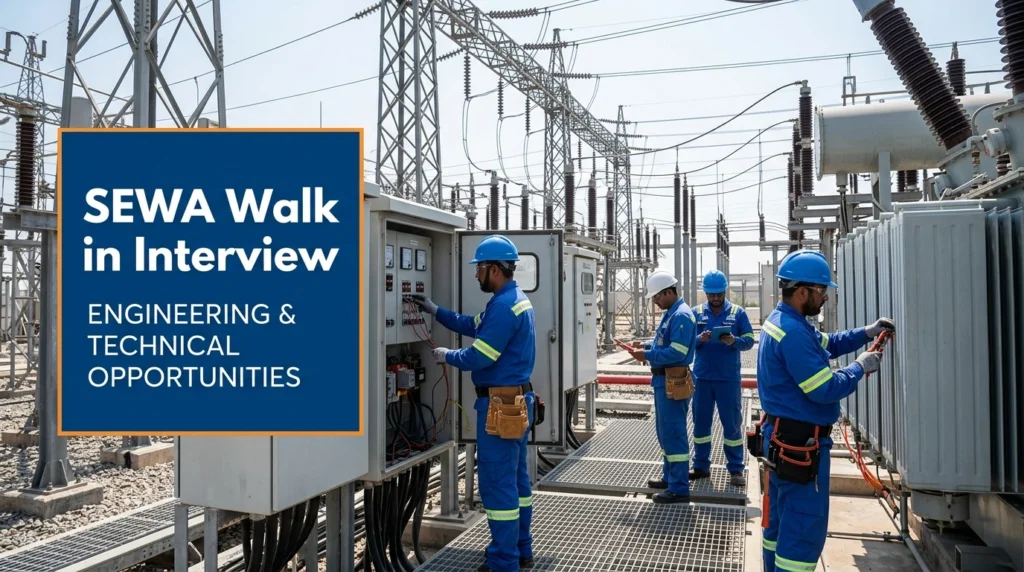
The Power Grid vs. The Water Mains: Your Deployment Zones
Department heads assign technical crews based on their high-voltage clearance or their ability to handle heavy hydraulic machinery.
The Electrical Distribution Network
Working the power grid means you are on 24/7 call for sudden blackouts during the brutal August summer heat.
- Transformer Maintenance: Replace blown fuses inside neighborhood distribution boxes while wearing mandatory arc-flash protective suits.
- Cable Jointing: Splice and seal heavy underground copper cables using industrial heat-shrink materials to restore grid connectivity after contractor damage.
The Gas & Water Infrastructure
Handling the liquid and gas side requires working deep inside muddy trenches alongside heavy excavators.
- Leak Containment: Isolate cracked municipal water mains by manually turning massive butterfly valves scattered across industrial zones.
- Meter Calibration: Inspect and replace tampered commercial gas meters at local restaurants to ensure accurate billing for the government.
The Hidden Reality of Government Utility Work
- Emergency Call-Outs: When a power cable faults at 2 AM on a Friday, your phone rings, and you are expected on-site within 45 minutes.
- Extreme Danger: You are dealing with live city-level electricity and highly pressurized natural gas. One wrong cut in a trench can cause a massive explosion.
- Public Confrontation: Angry residents will shout at you when their AC stops working in the middle of July while you are trying to fix a blown transformer.
- Strict Hierarchy: Government authorities operate on military-level discipline. Arguing with a senior Emirati supervisor over an operational procedure will get you suspended.
FEATURED “HOT JOB”: WATER METER INSPECTOR
SEWA requires active field staff to visit residential areas and check water usage devices for accurate monthly billing.
- Compensation: 3,000 AED Base (Plus daily travel allowance).
- Placement: Various neighborhood zones across the Sharjah Emirate.
- Benefits: Official government health insurance, 30 days of paid holiday, and a company transport vehicle.
Core Requirements:
- Good physical stamina to walk through different building communities during outdoor shifts.
- Capability to read digital and mechanical dials clearly to record exact consumption numbers.
- Polite communication skills in basic English and Arabic to greet homeowners respectfully.
- Prepared to start the role quickly with a cancelled visa or valid NOC for public sector sponsorship.
How To Submit Your Application To SEWA
Forget about sitting down to discuss your soft skills with HR. The federal hiring committee drops physical utility components and raw electrical blueprints right on the table to test your street-level survival instincts.
The Federal Clearance Desk
Strict municipal security protocols are in full effect before you even reach the interview floor.
- Present your confirmed booking barcode directly from the official SEWA careers page at the main reception window.
- Administration clerks instantly run your passport number through the Sharjah Police CID network to guarantee your visa file has zero absconding cases.
The Fault Line Interrogation
A veteran grid supervisor slams a messy single-line power diagram down in front of you.
- Pinpoint the exact location of the simulated grid failure and map out the manual isolation route for the active circuit breakers.
- If you freeze up and forget the mandatory grounding steps, they will rip up your evaluation sheet right there to protect their current field crews.
The Heavy Hardware Trial
The evaluators march you out to a training yard built around a dead 11kV ring main unit (RMU).
- Grab the heavy insulated safety gear and manually crank out the massive switchgear mechanism using pure physical force.
- Touching the exposed copper busbars without checking for residual voltage first means you get permanently blacklisted from all municipal utility projects.

Haris Khan is a seasoned career consultant and GCC job market specialist with years of hands-on experience in technical recruitment and digital publishing. He specializes in tracking workforce demands across Dubai, Abu Dhabi, Saudi Arabia, and Qatar, helping job seekers connect directly with top-tier corporate employers, engineering firms, and luxury hospitality groups. Haris provides transparent, daily insights on walk-in interviews and direct HR hiring trends to safeguard candidates against recruitment scams and help them accelerate their career growth in the Gulf.